Royal Enfield Bullet 350 Features Explained What Do You Get for the Price
By 91Bikes Team
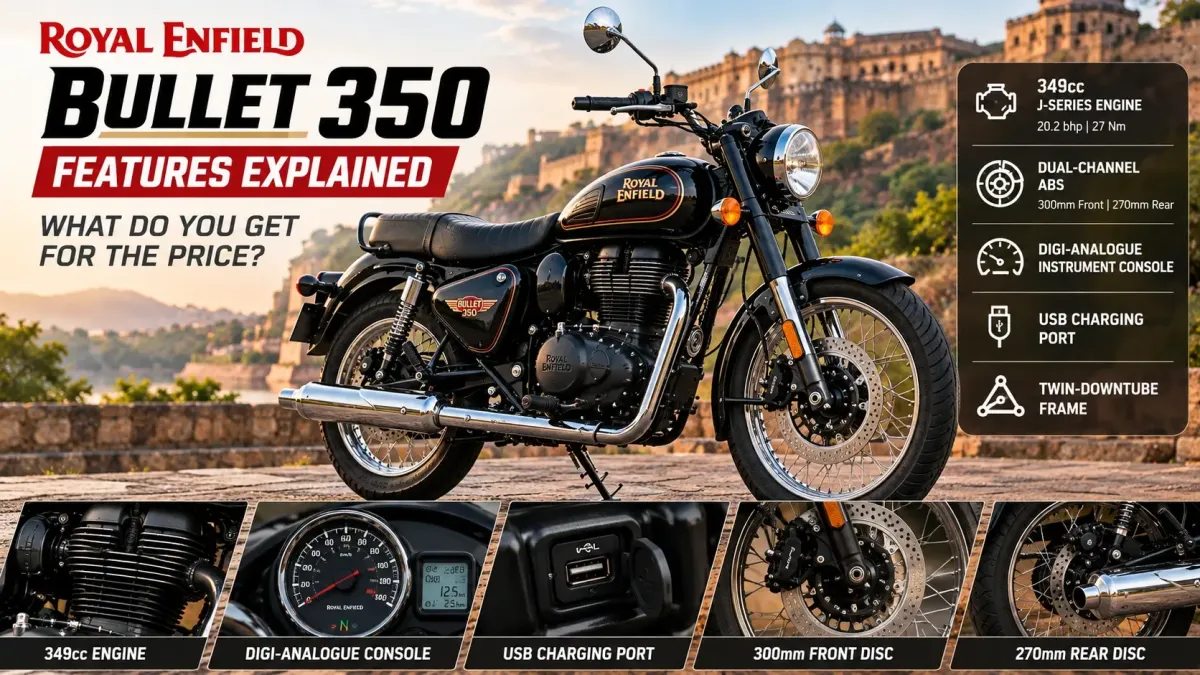
The Royal Enfield Bullet 350 is one of those motorcycles that doesn't need much of an introduction in India. Its familiar shape and long-running name remain a big part of its appeal, but the latest-generation Bullet is considerably more modern underneath than its old-school appearance might suggest.
It uses Royal Enfield's current 349cc J-series engine and gets features such as ABS, a digi-analogue instrument console and USB charging. At the same time, Royal Enfield has kept the design intentionally simple rather than loading the Bullet with electronics.
If you're considering buying one, here's a closer look at what the Bullet 350 actually offers and how the equipment changes depending on the variant you choose.
Royal Enfield Bullet 350 Engine
At the heart of the Bullet 350 is a 349cc, air-oil-cooled, single-cylinder engine. This is Royal Enfield's J-series motor, which is also used across other 350cc motorcycles in the company's line-up.
The engine produces 20.2 bhp at 6,100 rpm and 27 Nm at 4,000 rpm. It is paired with a five-speed gearbox.
Those figures make it clear that outright performance isn't the Bullet's main objective. Instead, the engine is designed around accessible low- and mid-range torque, which suits relaxed city riding and highway cruising.
| Engine | 349cc, single-cylinder, air-oil-cooled |
| Maximum Power | 20.2 bhp at 6,100 rpm |
| Peak Torque | 27 Nm at 4,000 rpm |
| Gearbox | 5-speed |
Classic Design, Modern Platform
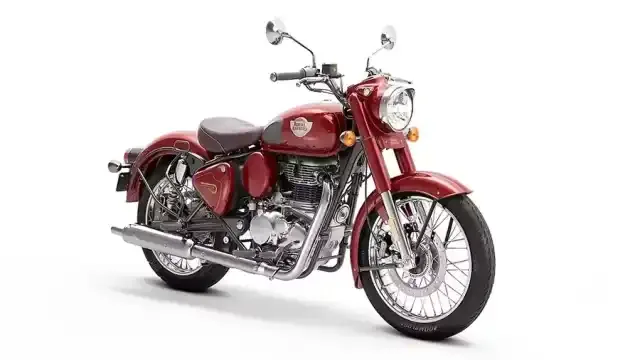
Royal Enfield hasn't tried to reinvent the Bullet visually. The motorcycle retains the traditional elements buyers associate with the name, including its round headlamp, teardrop-shaped fuel tank, long single-piece seat and upright riding position.
Look underneath, however, and the motorcycle is very different from older Bullets. The latest model uses a twin-downtube spine frame designed around the newer J-series engine.
That combination allows Royal Enfield to preserve the familiar Bullet appearance without relying on the much older mechanical platform used by previous generations.
What Features Does the Bullet 350 Get?
The Bullet 350 isn't trying to compete with feature-heavy motorcycles equipped with large TFT displays, multiple riding modes and extensive smartphone integration. Its equipment list is deliberately more straightforward.
Riders get a digi-analogue instrument console that combines a traditional analogue speedometer with a small digital display for essential riding information.
A USB charging port is also available, adding a useful everyday feature without changing the motorcycle's classic cockpit design.
Bullet 350 Instrument Console
The instrument cluster is a good example of how Royal Enfield has mixed old and new. The large analogue speedometer maintains the retro look, while the digital section provides information that would have been missing on older generations of the Bullet.
It isn't as sophisticated as the colour displays now found on some motorcycles, but that simplicity fits the Bullet's overall character.
Single-Channel vs Dual-Channel ABS
This is one of the more important differences to understand when comparing Bullet 350 variants.
Depending on the selected version, the braking hardware and ABS configuration can differ. Higher-specification versions use a 300mm front disc and 270mm rear disc supported by dual-channel ABS.
Lower versions use a simpler rear-brake arrangement with single-channel ABS. That makes the braking setup, rather than cosmetic changes alone, an important consideration when comparing variants.
Buyers should therefore check the exact brake and ABS specification of the variant they are considering instead of assuming every Bullet 350 has identical hardware.
Bullet 350 Suspension Setup
Suspension duties are handled by 41mm telescopic forks at the front and twin shock absorbers at the rear.
The setup reflects the Bullet's road-focused character. This isn't intended to be a sharp cornering motorcycle; the focus is more on predictable handling and everyday comfort.
19-Inch Front and 18-Inch Rear Wheels
Royal Enfield equips the Bullet 350 with a 19-inch front wheel and an 18-inch rear wheel.
The larger front wheel contributes to the motorcycle's traditional proportions and suits the relaxed nature of the chassis.
The spoke-wheel design also plays an important role in maintaining the classic Bullet appearance.
Royal Enfield Bullet 350 Dimensions
| Seat Height | 805 mm |
| Ground Clearance | 170 mm |
| Fuel Tank Capacity | 13 litres |
| Front Wheel | 19-inch |
| Rear Wheel | 18-inch |
How Comfortable Is the Bullet 350?
Comfort remains an important part of the Bullet formula. The handlebar position, relatively neutral footpeg placement and long seat create an upright riding posture rather than forcing the rider into an aggressive stance.
That should appeal to buyers who use their motorcycle for daily commuting as well as longer weekend rides.
The 805mm seat height is manageable for many riders, although shorter riders should still sit on the motorcycle before buying to see how comfortably they can place their feet on the ground.
Bullet 350 Key Features at a Glance
| Engine | 349cc J-series single-cylinder |
| Power | 20.2 bhp |
| Torque | 27 Nm |
| Transmission | 5-speed |
| Instrument Cluster | Digi-analogue |
| Charging | USB charging port |
| Front Brake | 300mm disc |
| Rear Brake | Varies by variant |
| ABS | Single or dual-channel depending on variant |
What Does the Bullet 350 Miss Out On?
Buyers coming from newer, technology-focused motorcycles may notice that the Bullet doesn't offer an extensive electronics package.
You don't get the sort of large colour TFT screen, multiple riding modes or sophisticated electronic rider aids available on some modern motorcycles.
That isn't necessarily an oversight. Royal Enfield has kept the Bullet focused on the basics: a torquey single-cylinder engine, traditional design, straightforward instrumentation and relaxed ergonomics.
Which Bullet 350 Variant Makes Sense?
The answer depends on what matters most to the buyer. If budget is the priority, the lower variants provide the same fundamental 349cc engine and unmistakable Bullet design.
Higher variants become more interesting for buyers who place greater importance on braking hardware and dual-channel ABS, along with their additional visual detailing.
Instead of looking only at paint schemes, it is worth comparing the braking specification carefully before deciding which version fits your requirements.
Is the Royal Enfield Bullet 350 Still Old-School?
Visually, absolutely – and that's intentional. Mechanically, however, the current Bullet is far removed from the older generations that established the name.
The J-series engine, modern frame, fuel injection, ABS and updated electrical equipment have brought the motorcycle into the modern era without removing the design cues that make a Bullet instantly recognisable.
That's arguably the main idea behind the current model: keep the Bullet looking like a Bullet while modernising what sits underneath.
What We Think
The Bullet 350 isn't the motorcycle to choose simply because you want the longest feature list for your money. There are motorcycles with more technology and equipment on paper.
Its appeal lies somewhere else. The relaxed 349cc engine, upright riding position and unmistakable design create a riding experience aimed at buyers who specifically want the Bullet character.
The biggest practical point when choosing between variants is the braking setup. Buyers who regularly ride on highways or place a higher priority on braking assistance should pay close attention to versions equipped with dual-channel ABS.
Royal Enfield Bullet 350: What You Need to Know
The current Royal Enfield Bullet 350 combines familiar styling with a much more modern platform. Its 349cc J-series engine produces 20.2 bhp and 27 Nm, while features such as ABS, a digi-analogue instrument cluster and USB charging add everyday convenience.
It remains deliberately simpler than many feature-heavy motorcycles, but that's part of its identity. For buyers interested in the Bullet 350, the most important step is comparing the different variants carefully – particularly their rear-brake and ABS configurations – rather than choosing purely on colour and appearance.